
Insights
Answers to the questions SaaS leaders ask before adding AI
Short, direct answers on adding agents to established vertical B2B SaaS, what production AI actually costs, choosing between AWS Bedrock, Azure AI and Vertex AI, and keeping gross margin intact.
Security
Is Your WordPress Site Vulnerable to PHP2Shell? Free Check for CVE-2026-109618 and CVE-2026-109619
EdTech
Teachers already use AI. Bring it inside your learning platform without a rebuild.
Workplace learning
Course completions may not renew your contracts. Proven skills can help.
15 answers to the questions asked before an AI build is approved.
Production AI
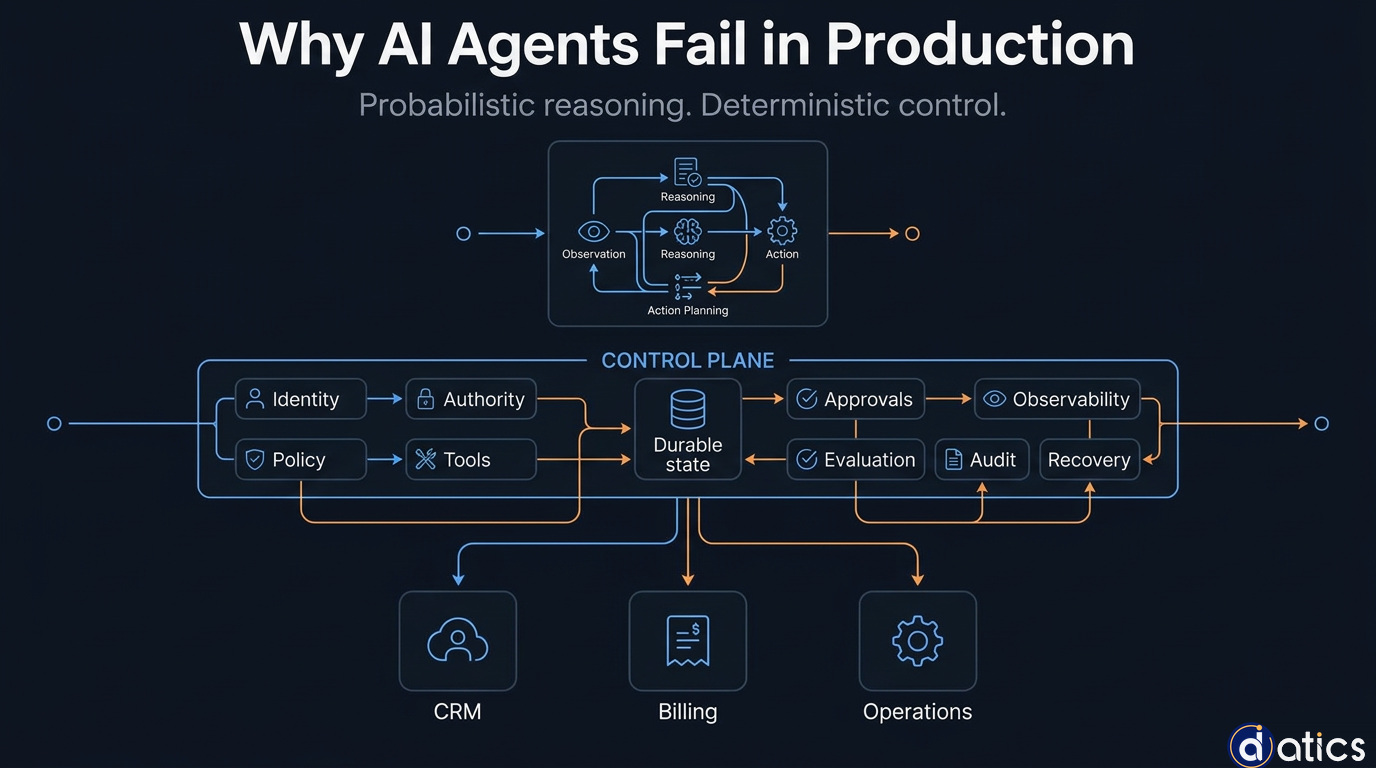
Why AI Agents Fail in Production: It's Not an Intelligence Problem
As AI moves from answering questions to taking actions, production success depends less on model intelligence and more on deterministic control around identity, authority, state, recovery and audit.
Read the articleSecurity
Is Your WordPress Site Vulnerable to PHP2Shell? Free Check for CVE-2026-109618 and CVE-2026-109619
Check your WordPress site's PHP2Shell exposure with PHP2Shell Guard, understand the result, and learn what to ask your host to update.
Read the answerEdTech
Teachers already use AI. Bring it inside your learning platform without a rebuild.
You add AI to an established learning platform by building on what it already has: your content library, your classes and rosters, your gradebook and your integrations. The AI drafts lessons, quizzes and feedback from that material. Teachers approve the work before any student sees it. Nothing about the platform has to be rebuilt.
Read the answerWorkplace learning
Course completions may not renew your contracts. Proven skills can help.
You add AI to an established corporate training platform by building on what it already holds: each customer's course library, their roles and skills framework, their completion records and their HR integrations. The AI drafts courses from the customer's own material, maps learning to skills and explains progress to managers. Admins approve what goes live. The platform does not need to be rebuilt.
Read the answerEdTech
Applicants ask at 11pm. Your admissions platform should answer, and book the next step.
You add AI to an established admissions or enrollment platform by building on what it already holds: each institution's catalog, admissions rules, CRM and documents. The AI answers applicant questions from that material, recommends programs, books advisor calls and pre-fills applications from uploaded documents. Staff approve anything that affects a decision.
Read the answerEdTech
Your buyers are asking about AI. Answer with a feature they'll pay for, not a rebuild.
Established EdTech SaaS teams can answer the AI questions in RFPs and renewals without a rebuild: pick one buyer outcome, build two or three related capabilities inside your own product in staging on synthetic or de-identified data, measure quality and cost per learner, then decide whether to include it or sell it as a paid AI tier. If you've already built or tried AI, score it first.
Read the answerEdTech
K-12 software vendors can ship AI without needing student data. Here is how.
A K-12 software vendor can add AI to its product without exposing student data by starting with staff-, teacher- and parent-facing features, building and testing on synthetic data, keeping production data in its own cloud and putting a person in front of anything that reaches a student.
Read the answerEdTech
Every new question is a report request. AI can let your SIS customers ask it themselves.
An SIS, analytics or student-success vendor adds AI most safely by letting staff ask plain-English questions of the data they can already see, answered as tables and charts with the query shown, using each institution's own definitions of terms like cohort, active and at-risk.
Read the answerBrownfield AI
How to add AI agents to an existing SaaS product without rebuilding it
A practical route to shipping AI agents inside an established B2B SaaS product: use the existing permission model, integration layer and business logic instead of rebuilding around the model.
Read the answerEngineering reality
Why vibe coding is not enough for mature SaaS
AI coding tools are excellent at generating code and blind to your constraints. Here is what mature vertical SaaS needs on top of them before anything reaches paying customers.
Read the answerCost
How much does production AI cost in SaaS?
The real cost of running AI in a SaaS product: inference, retrieval, storage, egress and engineering. Indicative bands and the variables that move them.
Read the answerPlatform choice
AWS Bedrock vs Azure AI vs Vertex AI for existing SaaS
A practical comparison of Amazon Bedrock, Azure AI Foundry and Google Vertex AI for teams adding AI to an already-deployed SaaS product.
Read the answerMigration
When should an AI workload move between clouds?
The defensible reasons to move an AI workload to another cloud, the reasons that are not worth it, and how to migrate without disrupting a live SaaS product.
Read the answerUnit economics
Why AI features can damage SaaS gross margins
AI turns a fixed-cost software business into a variable-cost one. Here is how margin erosion happens and how to price and architect against it.
Read the answerCost
How to reduce AI infrastructure cost in production
Concrete levers for cutting production AI cost in a live SaaS product: context discipline, model routing, caching, placement and GPU utilization.
Read the answerWant our view on your specific situation?
Describe the product and the capability you are considering. We will tell you how we would approach it.